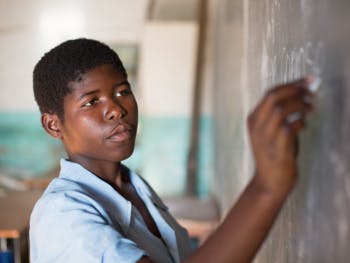
*Not actual representation. Image for illustrative purposes only.
Our Commitment, Collaboration
and Results-to-Date

Joia Mukherjee, Chief Medical Officer, Partners in Health

Hi, my name is Joia Mukherjee, and I am Chief Medical Officer for Partners in Health and I’m also an associate professor at Harvard Medical School in the division of Global Health and Social Medicine. Partners in Health is a non-governmental global health organisation. We work in twelve countries around the world and our main goal is to provide quality medical care to people in some of the poorest and most difficult to reach parts of the globe. This includes the Lesotho project, which is one of our three sites in Africa.

Today I am pleased to take you on a tour of this project and show you how we are working to scale up a novel approach to engage pregnant women with health services in some of the hardest to reach parts of the country. I will do this with the aid of my colleague Jennie Riley, the Lesotho Project Coordinator.

Lesotho carries one of the highest HIV burdens in the world and the socio-economic and socio-political climates leave women particularly vulnerable to HIV. Women are often left isolated when their husbands leave to seek work, and, on their husbands’ return, may be exposed to sexually transmitted diseases. Worryingly, maternal death rates in Lesotho are now one of the highest in the world and still increasing at 1,100 per 100,000 live births1,2. Interrupting the transmission of HIV from mother to child is critical in combating the scale of this epidemic. The need to reach out to women has never been more apparent.

The country’s mountainous and rugged terrain also poses several practical obstacles to accessing health services. Individuals often have to endure days of walking to reach any form of healthcare service, a challenge for anyone and for pregnant women in particular. On arrival, the barriers do not subside, as services are often closed or good quality care and treatment are lacking.

The maternal health and HIV project started as a small pilot at one of seven health facilities that Partners in Health supports in the mountains of Lesotho. At this first pilot health facility, we trained 100 specialised community health workers, many of whom are former traditional birth attendants, to educate and accompany women in their villages to the health clinic for services.

The joint goals of our collaboration are to….

  1. Ensure all pregnant woman receive a HIV test on their first clinic visit
  2. Ensure all women deliver their babies in a health clinic
  3. Support health centres in providing good quality staff, training, transportation, supplies and medicine

Overall, we want all women living in Lesotho to have access to quality care and to deliver their babies in a safe environment. We want the kind of healthcare for the women of Lesotho that any of us would want for our sisters, for our mothers, for our daughters. With this we can help reduce maternal death and the orphan epidemic in Lesotho and decrease the risk of mothers passing HIV onto their children.

The project includes several interrelated components. Let me take you through some of them…

  • We've engaged the services of proficient and passionate nurse-midwives to oversee the programme at each clinic and to provide skilled delivery and prenatal care services.
  • We’re training former traditional birth attendants to be specialized community health workers. The approximately 500 individuals who we’ve trained thus far now provide health education in their communities and physically accompany women to the clinic to access antenatal care, HIV testing and treatment and delivery services. They all receive ongoing training and a stipend for performing these services each month.
  • At each health clinic we’re building or renting mothers' waiting houses where women can reside for up to three weeks prior to their due date. As you can imagine, given the challenges of just travelling to a clinic, this is extremely important in assuring that the women of rural Lesotho are able to deliver their babies at a health facility with a skilled nurse-midwife present. Collaboration on this project has recently grown and the World Food Programme in Lesotho is now working with us to provide food to the houses.
  • We’ve put in place meaningful incentives for mothers to visit the health clinics for care and to deliver their babies. Specifically, we provide new mothers with baby packages that include hats, a blanket, a washtub, soap, clothing and also hygiene items that will allow them to better care for their baby.
  • A project currently under negotiation is the rehabilitation of a local hospital to accommodate women who require a caesarean section. A key factor in this project’s success will be the elimination of any fee. It has previously been found that removing this cost can lead to a three-or four-fold increase in the utilisation of services within a matter of weeks. [PIH Lesotho removed user fees at Mamohau Hospital as of April 1, 2011. In the first few days, patient volume more than tripled, from 55/day to 175/day. See story at: http://www.pih.org/blog/entry/removing-user-fees-dramatically-increases-patient-visits-in-lesotho/].

One of the biggest impacts of our programme to date has been the change in attitudes in terms of where women should be delivering babies. The norm is changing, which is a terrific achievement for such a short period of time. Attitudes are also changing in relation to women accessing additional services. We have seen the number of women who come to Bobete health clinic for more than one prenatal care visit increase by 70 per cent in just a year.

The numbers are of course important, but we are also proud of the positive dynamic that we have helped to create. There is a growing feeling among health workers, midwives and even the women themselves that they are a united front in tackling these myriad challenges.

This project has reinforced our beliefs about the importance of community engagement. You cannot simply impose a programme on a community – you need their buy-in. Our collaboration with village chiefs, traditional birth attendants and other individuals in the community, such as the mothers and mother-in-laws of the women this programme targets, has been extremely useful in this respect. Also, we’re learning more and more that in order to address women’s issues, we have to engage men as well. Actually, that’s been one of the challenges with this project since most of the men in Lesotho are gone for extended periods of time. Still, our work with village chiefs – who are of course men – has been critical to the overall success of the programme thus far. Finally, the project has reinforced the importance of considering the bigger picture and making sure all pieces of the puzzle are in place. It is no use, for example, offering services for mothers at a clinic if you are not going to overcome the geographic barriers for them to reach you.

Learn more about the Positive Action for Children Fund here.

FACT FILE

Project name:
The Maternal Health and HIV Lesotho Project

Run by:
Partners In Health

Region:
The southern African country of Lesotho

Population:
Mothers, children

Challenges:
Geographic isolation, lack of infrastructure and health services, female vulnerability, large and growing HIV epidemic, high maternal mortality

Activities:
Community health worker training, resource development, incentives and support